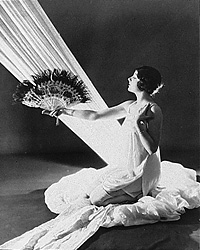
Lejaren A. Hiller Sr was a remarkable photographer known particularly for theatrically staged tableaus. Lejaren A. Hiller Sr. was born in Milwaukee, Wisconsin and studied photography in various locations before embarking on his long photographic career. Often Lejaren would spend all of his effort arranging the set and actors in his tableau, with an assistant actually making the final negative. Thusly, Lejaren is often construed as more of a "director" than "photographer."
Lejaren A. Hiller Sr. is often
remembered for his famous quote about photographic
technique:
 |
 |
|
An atypical portrait
by Lejaren A. Hiller Sr.
|
A typical tableau scene
by Lejaren A. Hiller Sr.
|
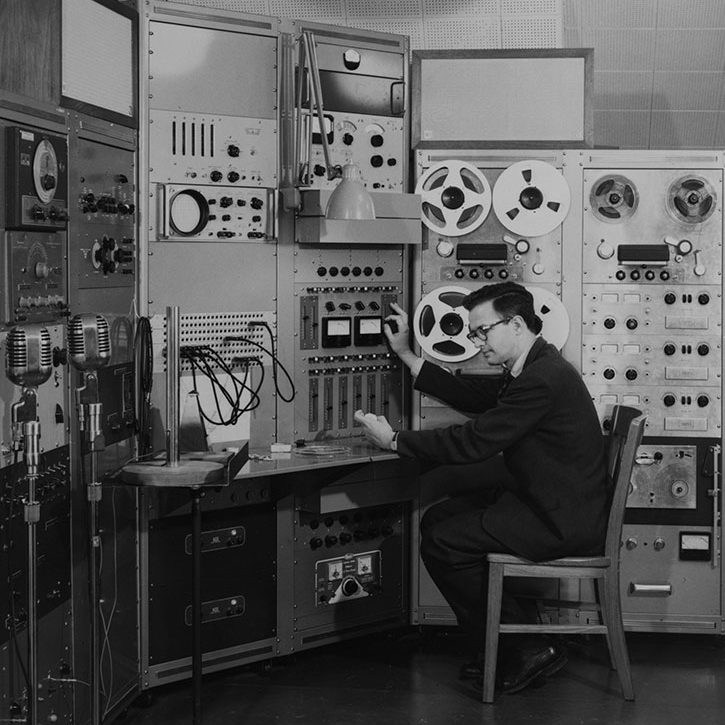
Lejaren A. Hiller Jr. was a notable pioneer in computer generated music of various kinds. He also experimented with various non-standard compositional techniques such as stochastic music, indeterminacy, serialism, Brahmsian traditionalism, performance art, etc. Lejaran A. Hiller Jr. occasionally collaborated with John Cage.
The world is not as orderly as you are implying. Very few people have archives of any kind, and it appears that neither Hiller Sr nor Jr have archives.
Film in 1931 was on nitrate stock. Nitrate file stock is flammable, and turns to powder over time. The powder is explosive at regular air pressure. Nitrate film stock which remains intact has generally been stored in temperature and humidity controlled individual vaults.
Cellulose acetate film, or safety film, is used in photography as a base material for photographic emulsions. It was introduced in the early 20th century by film manufacturers and intended as a safe film base replacement for unstable and highly flammable nitrate film. The motion picture industry continued to use cellulose nitrate supports until the introduction of cellulose triacetate in 1948, which met the rigorous safety and performance standards set by the cinematographic industry. The chemical instability of cellulose acetate material, unrecognized at the time of its introduction, has since become a major problem for film archives and collections.
WorldCat.org is a resource for locating unique, trustworthy materials that you often cannot find anywhere except in a library. By connecting thousands of libraries’ collections in one place, WorldCat.org makes it easy for you to browse the world’s libraries from one search box. https://search.worldcat.org/topics/welcome
Magazine articles
- Larry Frascella
- Aperture (Magazine) Archive
- Fall 1985
- D. John Turner
- Film History: An International Journal
- Indiana University Press
- Volume 19, Number 3, 2007
- A Portfolio for Diverse Performers and Tape (3)
- Algorithms I, Version I (1)
- Algorithms I, Version IV (1)
- An Apotheosis of Archaeopteryx (1)
- Computer Cantata (2)
- Metaphors (1)
- Quartet No. 6 for Strings (3)
- Sonata No. 2 For Violin And Piano (1)
- Sonata No. 3 For Violin And Piano (1)
- Sonata No. 5 For Piano (1)
- String Quartet No.5 (in quarter tones) (2)
--------------------
All written content of this web site is solely the editorial opinion of Jeffrey Sward. All images, graphics, and written content of this web site, including the html files, are creative products covered by copyright law. All content copyright Jeffrey Sward 1975-2019. All rights reserved. No portion of this web site or its constituent elements may be reproduced in any form, by any means, without prior written permission. So there.